
One system for the whole food chain

Consumer safety and carbon footprint

HACCP+ is an international initiative supporting quality, traceability and sustainable development in the food and feed chain. It certifies food, feed, packaging, non-food products and technical equipment used in the food and feed industries — and applies the same rules to every supplier that can affect food.

Version: 01/PLUSStatus: working draftScheme owner: Belevo Sp. z o.o.
Starting point

Safety does not stop at the food producer

Food is affected by everyone who supplies a plant with a raw material, a product or a service.

Packagingmigration of substances
Machineareas that are hard to clean
Lamp and floorbreakage, flaking
Cleaning agentresidues on lines
Water and gasesimpurities, supply gaps
Agency workerno health check or training
The question everyone shares

How could my product or service cause a hazard at my customer’s site?

Every organisation in the system answers it, from the farmer to the flooring supplier.

What HACCP+ is

Four areas in one standard

HACCP+ is a voluntary standard for the safety of products and services in the food chain, the feed chain and the industries that supply them. It combines organisation management, the HACCP system, product and service safety, and requirements on people, climate and the environment. Its layout follows the logic of ISO standards, which makes it easy to combine with ISO 9001 and ISO 22000.

1

Managing the organisation

Leadership, objectives, risk, audits and legal requirements. Chapter 3.

2

HACCP system

Hazard analysis, prerequisite programmes, CCPs and validation. Chapter 4.

3

Safe products and services

Traceability, information for the customer, withdrawal. Chapters 5–6.

4

People, climate, environment

Carbon footprint, sustainability, working conditions. Chapters 7–8.

Structure

A common core and sector guidance

Chapters 3–6 and 8

Common requirements

They apply to every organisation, whatever its sector or size.

ST-01 – ST-13

Technical specifications

Requirements specific to an activity family.

Chapter 7

Climate, optional

Carbon footprint and sustainability, when the organisation chooses.

B1 – B6

Additional modules

Special claims, such as GMO-free, organic or feed.

Annexes E and F

Applicability and recognition

The applicability table and the rules for recognising other certificates.

Read the full description of the standard →

Impact levels

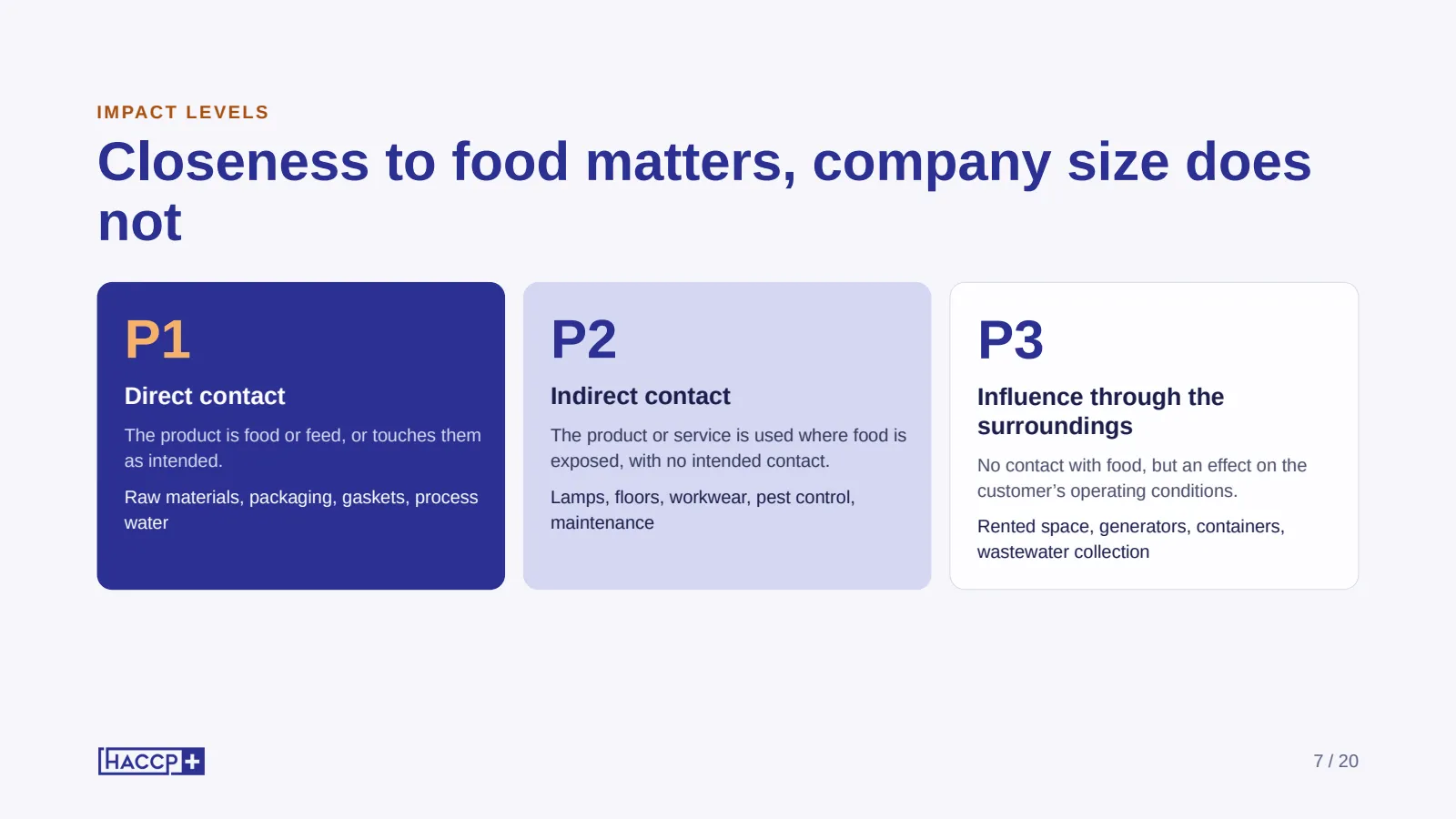
Closeness to food matters, company size does not

P1

Direct contact

The product is food or feed, or touches them as intended.

Raw materials, packaging, gaskets, process water

P2

Indirect contact

The product or service is used where food is exposed, with no intended contact.

Lamps, floors, workwear, pest control, maintenance

P3

Influence through the surroundings

No contact with food, but an effect on the customer’s operating conditions.

Rented space, generators, containers, wastewater collection

Activity families

13 technical specifications

Participants in the food chain (ST-01 to ST-04) and suppliers of products and services (ST-05 to ST-13). Each specification adds what is specific to its sector.

Unannounced inspections

Verified every day, not only on audit day

Throughout the three-year certification cycle HACCP+ inspections are unannounced. Depending on the type of activity, the organisation is informed 48 or 72 hours before the inspection.

Continuous readiness

Unannounced inspections keep quality constant and motivate staff to care about food safety and hygiene every day.

Adapted to the activity

Each activity family has its own specifics, so inspections follow the relevant technical specification.

Reliable consumer information

Labelling requirements are verified, with a focus on allergens, gluten-free, vegetarian and vegan food and food for children.

Implementation

Six steps to conformity

  1. Scope and family

    Sites, processes, products and services

  2. Impact levels

    P1, P2 or P3 for each product and service

  3. Applicability table

    What applies, what does not, and why

  4. Implementation

    Chapters 3–6 and 8 plus the right specification

  5. Internal audit

    A check of the system and a management review

  6. Independent assessment

    An audit carried out by an independent body

See the certification process →

Benefits

What the supplier and the customer gain

The organisation

  • one system instead of several
  • existing certificates are recognised
  • requirements fitted to the sector
  • clear rules for exclusions

The customer

  • suppliers assessed under the same rules
  • the information needed for its own hazard analysis
  • fast notification of an incident
  • suppliers from different sectors can be compared
Presentation

The system in 20 slides

Browse the official presentation of HACCP+ 01/PLUS slide by slide, with a short summary of each slide, or download it as a PDF.

Open the presentation

Slide 7: impact levels P1, P2 and P3
Documents

Key documents

Every document is described so you know what it covers and who it is for. Available in English, Polish and Spanish.

HACCP+ Standard — Consumer safety and carbon footprint

Working draftEN · PL · ES

The normative text: chapters 3–8 with lettered requirements and auditor guidance, Annex A and B1–B6 (additional modules), Annex C (link with Codex Alimentarius), Annex D (reference documents), Annex E (applicability table O/W/X) and Annex F (recognition of ISO 9001, ISO 22000/FSSC 22000 and ISCC certificates).

For
Organisations preparing for certification, consultants, auditors
Version
01/PLUS · 11.2026

HACCP+ system presentation (20 slides)

CurrentEN · PL · ES

A 20-slide overview: why safety does not stop at the food producer, the four areas of the standard, the common core and technical specifications, impact levels P1–P3, hazard analysis from two perspectives, activity families ST-01–ST-13, Annexes E and F, chapters 7 and 8, modules B1–B6, benefits and six steps to conformity.

For
Anyone new to HACCP+
Version
01/PLUS · 11.2026

All documents and technical specifications →

Frequently asked questions

What is HACCP+?

HACCP+ is a voluntary standard for the safety of products and services across the whole food chain. It applies the same rules to food and feed businesses and to their suppliers of materials, equipment and services, and adds optional climate and sustainability requirements.

Which organisations can use HACCP+?

Any organisation whose product or service can affect food: participants in the food chain (ST-01 to ST-04) and suppliers of products and services such as packaging, machinery, buildings, chemicals, on-site services, utilities, staff, property and waste management (ST-05 to ST-13).

Does company size matter?

No. What matters is how close the product or service is to food — impact levels P1, P2 and P3. Size, cost or lack of time are never grounds for excluding a requirement.

Do existing certificates count?

Yes. Under Annex F, ISO 9001 covers most of chapter 3, ISO 22000 and FSSC 22000 most of chapter 4, and ISCC mass balance and module B4. The auditor checks only what the certificate does not cover, provided it was issued by an accredited body, covers the activity and has no open major nonconformities.

Are HACCP+ inspections unannounced?

Yes. Throughout the three-year certification cycle inspections are unannounced. Depending on the type of activity, the organisation is informed 48 or 72 hours before the inspection.

More questions and answers →

Next step

Ready to assess your organisation against HACCP+?

Tell us about your activity family, sites and products. We will reply with the scope, timing and a quotation.